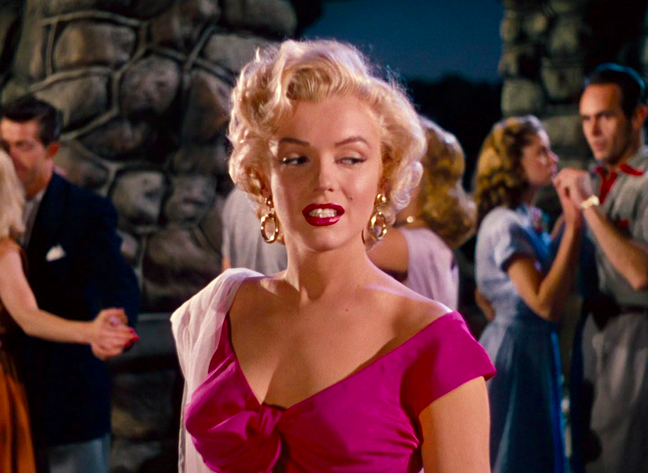
Let’s be clear: film noir isn’t a genre. Westerns, war movies and horror films are all genre pictures with motifs that signal the kind of film you’re watching. But noir isn’t as easy to spot.
There are noir cliches — shadows cast by venetian blinds, voice-over narrations by weary, defeated perps and fall guys, and flashbacks that seem to make time dissolve and rearrange itself like a Salvador Dali clock face. But a sizable number of dyed in the wool noirs have none of those elements.
Doomed choices, desperate people, disposable lives
Factors much deeper than cosmetics distinguish noir from other films — ethics and outlook. Noir is a moral condition borne out of doomed choices, tragedy, desperate people and disposable lives. Some might argue that genre is defined by recurring themes as well as recurring visual conventions, but many themes seen in noir — man’s inhumanity to man, corruption, fatalism — are hardly exclusive to noir.
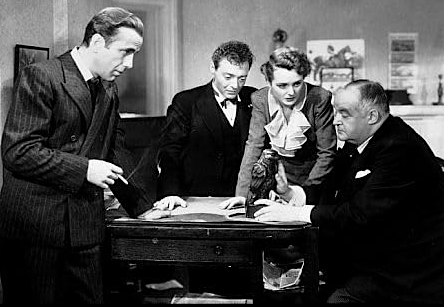
Many consider “The Maltese Falcon” (1941) the first American noir, and it has no voice-over narration, flashbacks nor particularly shadowy settings. Private detective Sam Spade (Humphrey Bogart) isn’t the morally ambiguous type that noir antiheroes are supposed to be. He maintains a strong code of ethics in a morally compromised world, only pretending to be as corrupt as the unscrupulous characters with whom he does business on the mean streets of San Francisco.
What makes ‘The Maltese Falcon’ noir? Its darkly existential outlook
The film’s urban setting and the gaggle of cold-blooded adventurers who hire Spade are both common noir elements. But what makes “The Maltese Falcon” noir is its darkly existential outlook. Spade falls for Ruth Wonderly (Mary Astor), knowing that she can’t be trusted. It’s a bad move on his part, like the affair he had with his business partner’s wife. A morally grounded, imperfect man living in a world peopled by shady characters, Sam is doomed to repeat his mistakes. He falls in love and ignores his instincts for self-preservation, but the promise of romantic love proves to be a mirage. The one element he sticks by is his determination to see that justice is done. Everything else is negotiable.
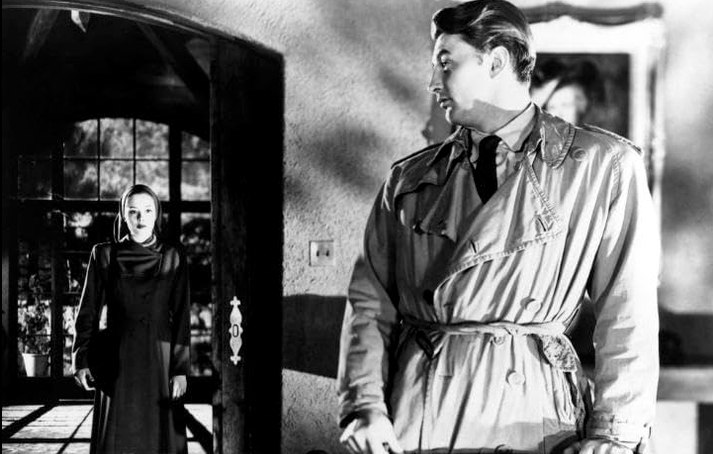
The big city makes only a cameo appearance in “Out of the Past” (1947), a quintessential Classic Noir that helped define films of that era. The action mainly takes place in the California countryside, Lake Tahoe and Acapulco, with brief segments in San Francisco. Crime and corruption stand out in bas relief against the unspoiled beauty of Bridgeport, Calif., where former private eye Jeff Bailey (Robert Mitchum) runs a gas station and is hiding out in plain sight. His former employer, gangster Whit Sterling (Kirk Douglas), catches up with him and drags him back into the life he’s trying to leave behind.
The film is not free of all noir affectations. Bailey is forced to revert to his former identity as private eye Jeff Markham, for which he dons a fedora and trench coat, like Bogart in “The Maltese Falcon,” and much of the story is told in a shadowy flashback.
A cursed man, Bailey is unable to shed the skin of his past identity, and because of that, criminality infiltrates an otherwise idyllic community. When Sterling’s henchman comes gunning for Bailey/Markham on the sun kissed banks of a pristine Bridgeport stream, a violent scene plays out amid the countryside’s natural beauty. It’s a tale as dark as any urban noir, with Bailey powerless to avert his dismal fate, all for the love of a perfidious woman.
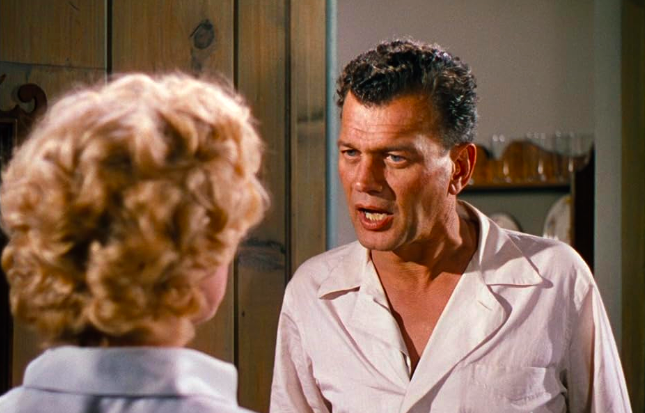
Water is both a symbol of rejuvenation and peril in “Niagara” (1953). The unhappily married George and Rose Loomis (Joseph Cotten and Marilyn Monroe) check into a motel cabin near the falls for what’s supposed to be a romantic and restorative stay.
George, a Korean War vet, was recently hospitalized for battle fatigue and is still in a deep depressive state — he even feels belittled by the falls’ grandiosity. He’s also vexed by Rose, a voluptuous flirt who seems to savor every opportunity she can find to stir up his jealousy. George is so smitten with her that he can’t summon the strength to break away. Rose pretends to be the doting housewife and caretaker of her troubled spouse, but is is up to no good.
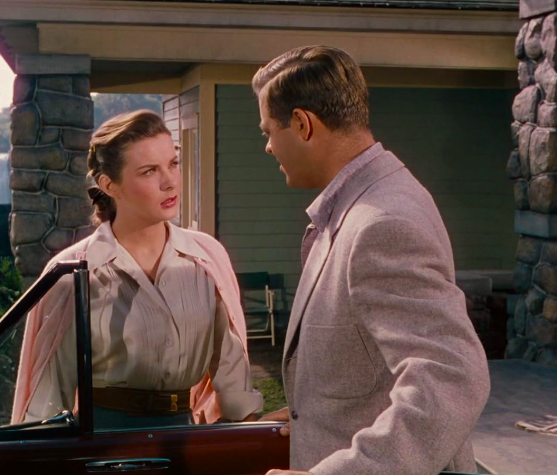
Jean Peters, Max Showalter, “Niagara.”
She has a paramour, and they’ve cooked up a diabolical plan that will have George meet an unfortunate accident. It’s cruelly ironic that such a deadly scheme is set to take place in the epitome of romantic settings.
Contrary to the strictures of noir, much of the action in “Niagara” plays out under pure sunlight within a paradisal setting, far from the dusty corners of the city. Not only does the film not use voice-over, flashbacks or take place in the city, it’s filmed in Technicolor, another violation of the noir canon.
Despite all that, what makes “Niagara” a noir is the cold, calculated spousal murder plot, and the ethics of one who believes that inconvenient marriage vows are easily overcome with lethal force. Human life is disposable — murder is the key to breaking unwanted attachments.
The mood, settings and narration associated with noir don’t define a genre. They recall a fashionable style that elicits a nostalgic twinge, even for those who weren’t born until after the Classic Noir era passed. The core of noir is tragedy: inescapable doom, the cold-blooded acts of desperate people, murder committed carelessly or with mechanical precision. Noir isn’t a style, it’s a statement about the dark side of human nature. It holds up a mirror to us, and challenges us to not look away.
We remember the shadows because they’re visually striking. We remember noir because it tells uncomfortable truths.
— Paul Parcellin