In noir, dark characters who aim to control the vulnerable are easy to spot. Blackmailers, femmes fatale and hardened criminals exert their grip on others in unsubtle ways. But sometimes the aggressor arrives with a smile and a bouquet of roses. He may present a polished image, but his intentions are always unsavory.
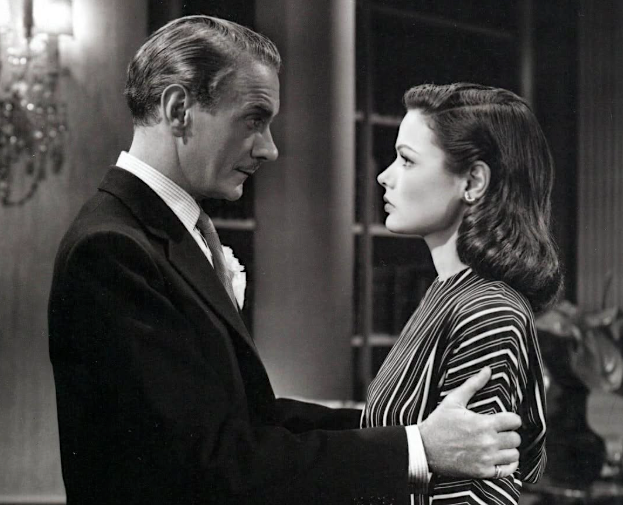
Clifton Webb, Gene Tierney, ‘Laura’ (1944).
In “Pygmalion,” Henry Higgins worked to remold Eliza Doolittle’s rough exterior and educate her in the ways of the upper class. Likewise, three figures in noir try to reshape women to fit their own agendas. Each of them believes his motive is benign, but beneath the surface self-interest and sinister plans lurk.
He sees others as lumps of clay to be sculpted into perfect objects.
Deadly Fame ‘I Wake Up Screaming’ (1941)
The sheen of celebrity can be bestowed upon any poised woman of beauty, provided that a well connected publicity agent is pulling the strings. That’s the case in “I Wake Up Screaming” (1941), a lusciously shot melodrama set in a shadowy and forbidding Manhattan. On a whim, sports promoter Frankie Christopher (Victor Mature) transforms a waitress into a glamour girl. It’s all just a lark for Frankie — or is it? Beneath his laid back facade he’s an image-obsessed social climber who treats others as marketable commodities. He hides his humble ethnic roots (his birth name is Botticelli) by rebranding his own persona, much as he does for his clients. Utterly immersed in the publicity game, he fails to see others as independent beings and instead treats them as lumps of clay to be sculpted into perfect objects.
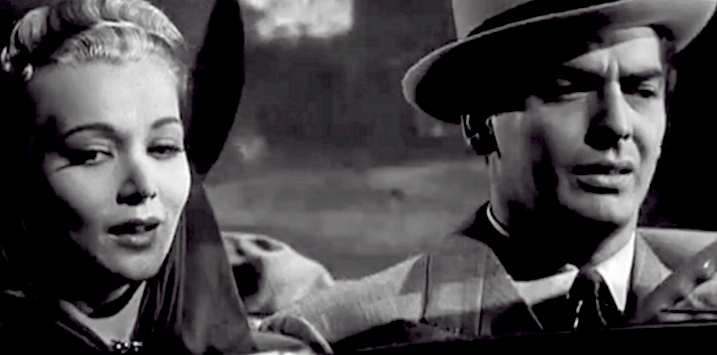
Carole Landis, Victor Mature, ‘I Wake Up Screaming.’
His experiment with the waitress is a success, but overnight fame has an intoxicating effect on her. When the budding star is found murdered, Frankie’s attitude is surprisingly cavalier. He becomes aloof and distant. But when a corrupt police detective tries to link him to the killing, he drops his manufactured facade. Suddenly, the approving world in which he has thrived develops a sharp set of teeth, and no amount of charm and bonhomie can save him.
In attempting to master his trauma, he recreates his idealized object of affection.
Torment and Obsession ‘Vertigo’ (1958)
Jimmy Stewart is the traumatized former police detective Scottie Ferguson who agonizes over his imagined responsibility for a fellow officer’s death in the line of duty. He then finds himself embroiled in another tragedy involving the death of a woman, the wife of a friend, whom he was supposed to be surveilling and protecting.
When, by chance, he meets another woman who looks identical to the deceased, he persuades her to let him curate her wardrobe and change her hairstyle and makeup to match that of the dead woman. Ferguson’s tormented conscience is soothed as she seems to transform into the departed woman, whom he’d begun to fall in love with.
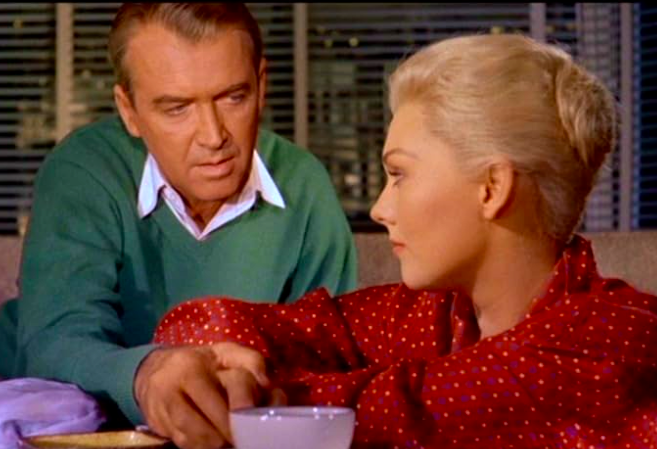
James Stewart, Kim Novak, ‘Vertigo’ (1958).
He means to support and protect this surrogate, but in doing so becomes obsessed with keeping her under his control. As he dictates the color and style of her clothing and cosmetics, his devotion to precise detail borders on the fetishistic. In attempting to master his trauma, he recreates his idealized object of affection, stripping the real woman of her own identity to serve his psychological comfort.
As she indulges Ferguson’s obsessions, we sense an undercurrent of dread beyond her initial unease, and later we find out why. Conversely, in a diabolical plot, the detective is himself being manipulated and exploited.
Despite his frenzied efforts, Ferguson’s desperate attempt to free himself of psychological burdens ultimately fails. Controlling and possessing others, he finds, is not the answer.
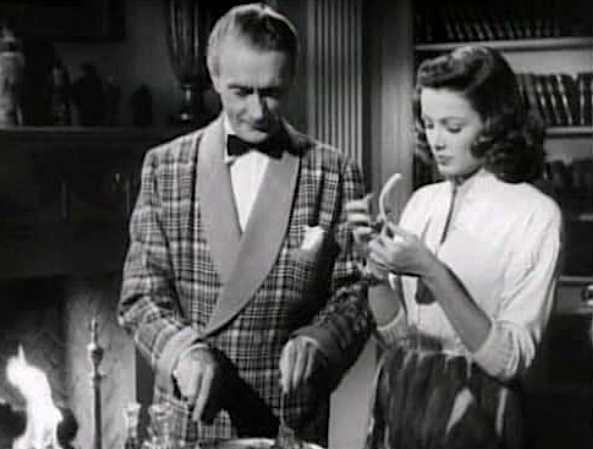
Clifton Webb, Gene Tierney, ‘Laura.’
A Fine Museum Piece: ‘ Laura’ (1944)
Aging gossip columnist Waldo Lydecker (Clifton Webb) becomes obsessed with the much younger Laura Hunt (Gene Tierney), but his attraction is apparently not romantic in nature — they may while away the hours together before a roaring fireplace, but not once do we see them embrace or even touch. We might infer that Waldo is a gay man — production codes of the day prohibited direct references to homosexuality.
He takes promising copywriter Laura under his wing and reshapes her into a sophisticate fit to be his protégée as he hobnobs with the upper crust of society. For Waldo, Laura is a blank canvas on which he can create his ideal woman, allowing him to sublimate his inner desires. But like the rare antiques Waldo keeps in vitrines in his parlor, Laura is an object of beauty that he jealously guards.
For Waldo, Laura is a blank canvas on which he can create his ideal woman.
His painstaking efforts to dress and educate her, making her acceptable to high society, come from something less than an altruistic impulse. Ultimately, his urge to command her every move is quietly monstrous and suffocating.
At first Laura is a willing recipient of Waldo’s tutelage, but her eventual interest in other men threatens his dominance over her. With Machiavellian aplomb, he maintains his control of her love life by extinguishing the sparks of romance between her and any suitors who come courting. When Waldo begins to lose his grip on her, we see the darkness beneath his snobbery and cultivated sophistication. He harbors disgust for those he sees as beneath him, and that’s nearly everyone else. He wishes to inhabit a perfect world occupied by only him and his carefully fashioned protégée. But Laura has plans of her own.
Like Henry Higgins before them, these men confuse love with authorship. They mistake possession for devotion and mentorship for benevolence. Their creations may gain glamour and status, but only so long as they remain obedient masterpieces. Once their living sculptures begin asserting their own desires, the sculptors reveal the darkness beneath their cultivated generosity.
— Paul Parcellin