In the often disjointed world of film noir, a mirror is seldom just a mirror. Those silvery reflective surfaces can suggest a lot of things: paranoia, dual personalities and narcissism, to name just a few.
They also distort reality. Facing mirrors may reflect the image of a figure into infinity, suggesting a splintered, dissociated personality.
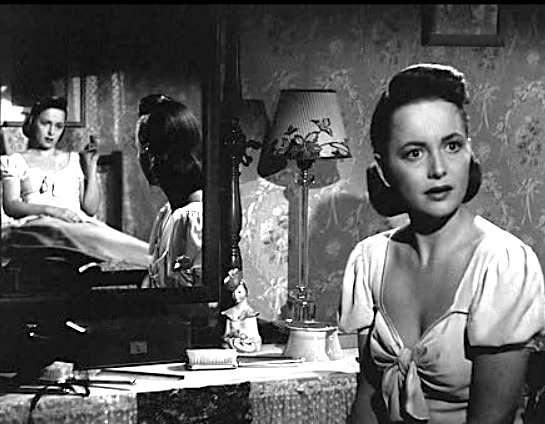
Olivia de Havilland, ‘The Dark Mirror.’
Mirrored glass can shatter, symbolically revealing a character’s fractured inner thoughts and perhaps a malformed understanding of the world around him or her.
Here are three noirs with reflective surfaces that tell us more than what meets the eye.
Seeing splintered personalities
‘The Dark Mirror’ (1946)
Noir is obsessed with the idea that evil and innocence can coexist in one person. But what about a pair of identical twin sisters — can one be good and the other sinful? Sisters Ruth and Terry Collins (both played by Olivia de Havilland) are persons of interest in a homicide investigation that’s hit a brick wall.
All the while we see reflective images that are visual clues about the sisters’ mental states — at one point they’re both reflected in a bedroom vanity mirror and it’s as if we’re seeing two halves of a split personality.
Director Robert Siodmak lets us to wonder if we’re seeing one woman or two — is this the depiction of a divided personality?
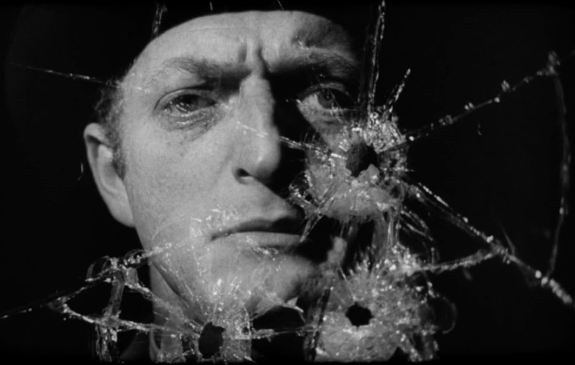
Everett Sloane, ‘The Lady from Shanghai.’
‘The Lady from Shanghai’ (1947)
Elsa Bannister (Rita Hayworth) is more a mirage than a living, breathing human. She’s composed of an infinite number of reflective images that never merge into one coherent being — more optical illusion than flesh and blood.
In the finale of “The Lady From Shanghai,” the image of Elsa is repeatedly reflected and fractured in a carnival’s house of mirrors. She and her husband, Arthur (Everett Sloane), shoot it out. Glass splinters and we see multiple reflections of them battling to the death.
Elsa’s murderous intentions overlap with Arthur’s desperate attempt to unmask her true character. But no single image sums up Elsa’s truth — she is unknowable. As bullets fly and shards of glass fall, her artificial facade collapses. In the end, Arthur is destroyed by his need to believe one version of her is real — a dangerous obsession, indeed.
Unmasking Elsa’s real character: No single image sums up her truth — she is unknowable.
‘Kiss Me Deadly’ (1955)
Private eye Mike Hammer inhabits a world gripped by nuclear age paranoia. The bomb casts a fearful shadow around the globe. In Mickey Spillane’s novels, Hammer plies his trade in New York City.
In “Kiss Me Deadly” he’s transported to Los Angeles, chasing a suitcase full of hot nuclear soup that’s stashed somewhere in the city. Hammer, as well as some dark forces, are after it.
At one juncture, he glances into a vending machine’s mirror revealing someone lurking nearby, waiting to pounce — his foes seem to follow him everywhere. But when he gazes into mirrors elsewhere he never seems to self-reflects on his jagged emotions or behavior.
He’s a man of brutal action in an unstable world where morality is crumbling. Surrounded by mirrors, Hammer can’t see himself clearly. He’s a harsh model of a modern narcissist living on a planet doomed to nuclear winter.
If they have one thing in common, noir antiheroes all seem to share a similar blind spot. They see a mirror’s polished surface but fail to recognize the manipulator behind it — until it’s too late.
— Paul Parcellin