 |
Angie Dickinson, Lee Marvin and Carroll O’Connor
in ‘Point Blank’ (1967). |
Why is L.A. the location of choice for so many crime films and stories about the dark side of life? Maybe it’s just because the bulk of all film production is done in Hollywood and it’s cheaper to shoot in your own backyard.
But that doesn’t explain why so many of the great crime novels take place in the City of Angels. A writer can set his story anywhere in the world without a thought of budgets, weather or union constrictions.
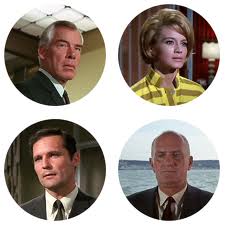 |
Clockwise from top left, Lee Marvin,
Angie Dickinson, Keenan Wynn and John Vernon. |
It might be that L.A. is different from most American cities, especially those that were built long before the two World Wars. They project stability and tradition, while L.A. is still considered part of the Wild West — a desert outpost full of transients, dreamers and hucksters. The city is branded as uncontrolled urban sprawl with a casual atmosphere that fosters a variety of lifestyles and eccentricities. In other words, it’s what the rest of the country thinks is wrong with America. Be that as it may, the city might just be the perfect laboratory in which to examine 20th century mores.
So, it’s no wonder that British director John Boorman begins “Point Blank” in San Francisco and moves it to the City of Angels. San Francisco may be one of the country’s cradles of personal liberty, but it still has the look and feel of a city built on the bedrock of traditional values.
Staged as a sort of brutally real saga that slips into vaguely hallucinatory passages, “Point Blank” is the sort of altered reality you’d expect to see in a 1967 film, but the director is too good to let meaningless psychedelic spectacle overpower the story.
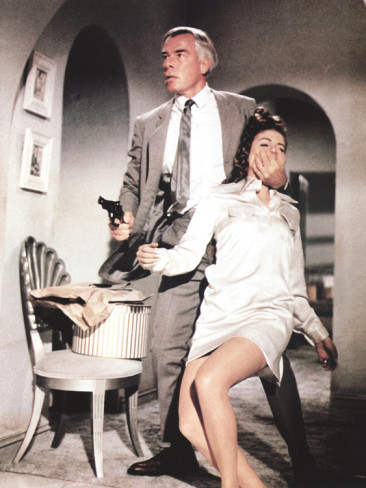 |
| Walker is double-crossed by his ex. |
Lee Marvin’s Walker, the career criminal who wants what is rightfully his, is cool and avoids the obnoxious pleased-with-himself vibe that a lesser actor would bring to the part. He’s down to earth, deadpan, resourceful and unstoppable.
Some conclude that the entire story is merely Walker’s dream. He’s left alone to die after being double crossed, but of course he gets back on his feet and goes after the ones who did him wrong.Keenan Wynn plays Yost, the mysterious agent who always seems to appear on the scene whenever the action is about to be pumped up. Throughout the film, he and Walker never make eye contact — could the agent be a mere figment of Walker’s imagination? But stranger events occur when Walker finds his two-timing wife. Check out the scene with the disappearing furniture – and the disappearing corpse.
Prior to “Point Blank” Boorman directed only black and white television and the film, “Catch Us If You Can” (“Having a Wild Weekend” in the U.K.), starring The Dave Clark Five. He says that he liked shooting “Point Blank,” his first color movie, in the dark because it makes the color palette monochromatic. Trivia fans will want to note that, at one point, the action moves to a house with a swimming pool in Hollywood Hills. It’s the same house that the Beatles lived in during their first tour of America.
 |
| Bright yellows and golds prevail in Angie’s scenes. |
Despite his emphasis on darkness, Boorman uses color as an expressive element throughout the film, and carefully controls the range of tones filling each scene. The film begins in washed out grays and blues, progresses to yellows and golds, especially in Angie Dickinson’s scenes, shifts to greens, and as the action heats up toward the end, reds and oranges prevail. Walker, wearing a red-brick colored jacket seems to fade into the walls as the film comes to its conclusion.
You could call Point Blank a revisionist noir, because it’s in color and is not dialog driven. Perhaps the film’s (then) modern-day take on the genre might be the missing link between black and white crime dramas of yesteryear and the sun-drenched Technicolor world of neo-noirs such as “Chinatown” and “L.A. Confidential.”Color aside, “Point Blank” is thoroughly character driven. Walker is relentless in his pursuit of the money he’s owed, but his doggedness only grows more intense even when the money becomes unimportant. He’s driven to get to the bottom of the mystery that has been plaguing him. His world is in shambles, but without this maniacal game of cat and mouse he’s initiated there’s nothing left in his life. Once the battle is over, there will be nothing to celebrate, but he continues because he has no other choice.