Author: pparcellin@gmail.com
-
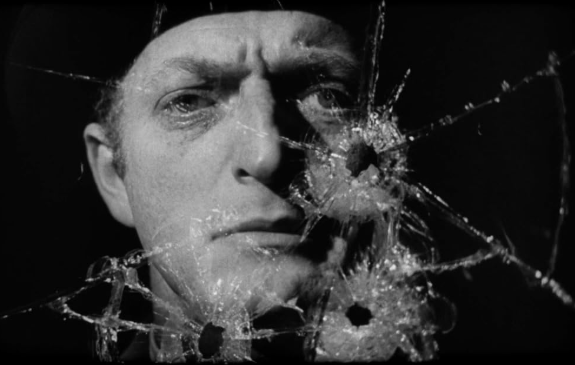
Noir mirrors: A broken world reflected in shattered glass
In the often disjointed world of film noir, a mirror is seldom just a mirror. Those silvery reflective surfaces can suggest a lot of things: paranoia, dual personalities and narcissism, to name just a few. They also distort reality. Facing mirrors may reflect the image of a figure into infinity, suggesting a splintered, dissociated personality.…
-
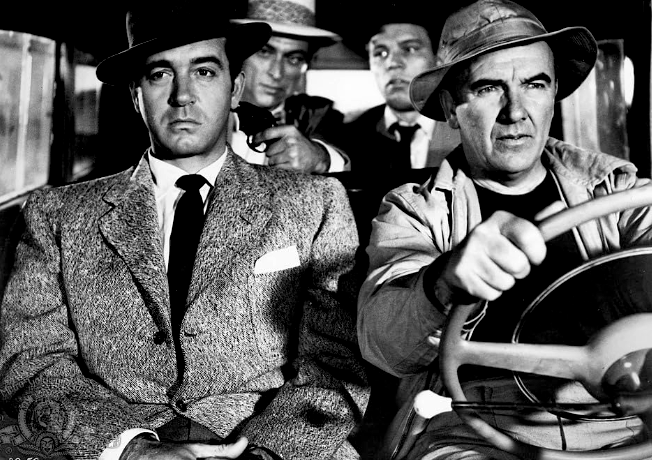
The simple art of robbery: Four noirs about loot — and gangs that will do anything to get it
Heist movies all have the same story at heart. A gang goes after a big score and the crooks use teamwork to get the loot. But tensions mount and plans of a clean getaway implode. The four heist movies below all have the same cash-grab backbone, but the details of each range from the simple…
-
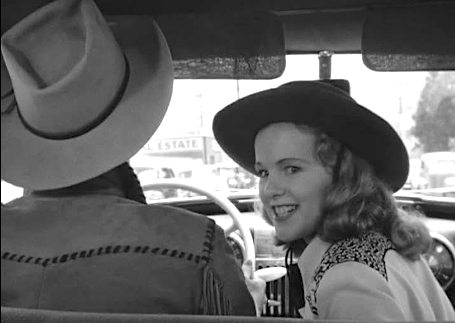
‘Gun Crazy’ has a classic robbery scene … but we never see the actual holdup
You couldn’t call “Gun Crazy” a romance, exactly, although it’s the story of a young couple who meet cute, fall in love — and share a passion for firearms. We meet Annie Laurie Starr (Peggy Cummins), a carnival sharpshooter dressed in a cowgirl outfit, performing in a sideshow. In the audience is Bart Tare (John…
-

Crime tourists, Part II: Americans clash with the underworld in foreign lands
DeForest Kelley, Cameron Mitchell, Robert Ryan, (unidentified), Robert Stack, ‘House of Bamboo’ (1955). We’ve already talked about films with Americans acting badly overseas . It seems that whenever a region is beset by war, a pack of jackals descends on the still twitching carcass of civilization to devour whatever meat is left on its bones.…
-

Crime tourists, Part I: Yanks behaving badly in foreign lands
Orson Welles, ‘The Third Man’ (1949). By Paul Parcellin Film noir loves morally sketchy locales — the kind of places where law and order is on life support and police can be manipulated like a vending machine. Like America’s Wild West, post-war Europe and Asia’s rubble strewn roadways were a magnet for drifters, bootleggers, grifters…
-

New York noir: 20 films that explore the big city’s dark corners
John Garfield, Thomas Gomez, ‘Force of Evil’ (1948). It might not come as news to you that noirs set in New York City look a lot different from the ones taking place in Los Angeles. The City of Angels is a sun bleached sprawl of low buildings between the ocean and desert. New York is…
-

Live it up! 11 essential nightclubs of noir
Karen Morley, ‘Scarface’ (1932) In noir, nightclubs are smokey hideaways where criminality thrives under moody lighting. Ritzier than typical barrooms, they are havens for hedonists and the racketeer elite. Crucial to these nightspots are floorshows. A chanteuse may whisper a torch song designed to torment an ex-lover sitting ringside. Her words spell out jagged details…
-

‘Ivy’ is pure evil under shimmering gaslight
Contains spoilers “Ivy” (1947) Even before the action begins we sense that something is rotten in Edwardian London. During the opening credits the orchestral music turns dark and a vase morphs into the faint image of a human skull. Clearly, this is going to be a horror show. Ivy Lexton (Joan Fontaine) seems pleasant enough,…
-

Burn, Hollywood, burn! Four noirs reveal the horrors of the screenwriting trade
Humphrey Bogart, Gloria Grahame, ‘In a Lonely Place’ (1950). You’ve probably heard that screenwriters get little respect in the big town, and by many accounts that’s true. They labor in isolation, punching out fresh ideas, pouring their deepest emotions onto their pages only to have their hearts broken. Their masterpieces are rewritten by faceless studio…
-

‘Scarlet Street’ at 80: Flirtations with a femme fatale can often lead to trouble — and sometimes murder
At her service. Joan Bennett, Edward G. Robinson, ‘Scarlet Street’ (1945). Contains spoilers When “Scarlet Street” premiered 80 years ago this month it was not uniformly praised by critics, and several cities outright banned it due to its dark content. The film hinted at such taboo topics as sex out of wedlock and prostitution, and…