We don’t see many elevator operators in our daily lives, but in noir they’re as common as neon signs and clouds of Chesterfield smoke. Elevator operators in film noir work in posh skyscrapers and skid row fleabags. They’re anonymous functionaries battling monotony and are nearly invisible extensions of the machinery they operate. Or they can be schemers, ever working side hustles that invariably come apart in a volley of gunfire.
For them, a poker face is essential. They’re hip to what’s going on in their building, and all it takes is a subtle wink to their confederates to set them straight. Their milieu is a car — a metal box, really — suspended by steel cables. Strangers climb aboard this intimate compartment that may float heavenward, or could conceivably fall into the abyss. And before long, someone is bound to take the plunge.
Here are a handful of noteworthy elevator operators of noir:
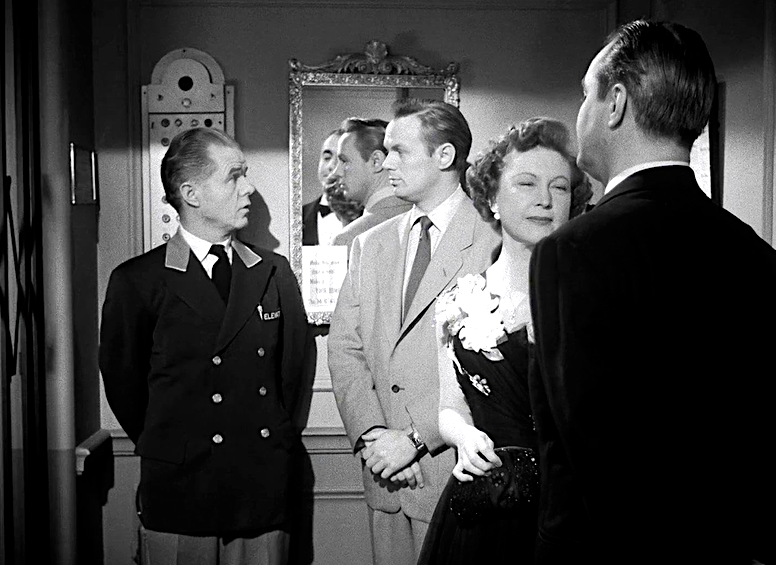
“Don’t Bother to Knock” (1952)
Eddie Forbes (Elisha Cook Jr.)
The road to hell is paved with Eddie Forbes’s good intentions. He wants to help his unemployed niece, Nell, so, he introduces her to Peter and Ruth Jones, guests at the hotel where he works. They’re attending a swank affair and their young daughter, Bunny, needs looking after while they’re gone. Nell gets the job, in part, no doubt, because Eddie forgets to mention that she recently finished a three-year stay at a mental institution and is unstable. Things begin to look grim for young Bunny, but another hotel guest, sensing that something is amiss, intervenes.
When the dust settles, Eddie is washed up in the elevator operating game and Nell will likely never again find work in childcare. However, as we’ll see later, actor Elisha Cook Jr. will have little trouble finding work as an elevator man
“Double Indemnity” (1944)
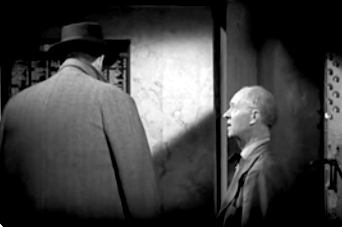
Joe Pete (John Philliber)
It’s a peaceful evening at Pacific All Risk Insurance Co. until company salesman Walter Neff raps on the door. Joe Pete lets him in and taxis him upstairs in the lift. He’s deferential to Neff, tries to make conversation, but Neff is tight-lipped, gruff even. “You look kinda all in,” Joe tells him. He’s puzzled by Neff’s odd behavior, not to mention the trail of blood he leaves as he makes his way to insurance investigator Barton Keyes’s office. As it happens, Neff has come to the office to record his confession to a murder and is on the verge of collapse. So much for Joe’s peaceful evening.
Pacific All Risk balked at selling a policy to Joe. “They said I have something loose in my heart,” he tells Neff. “I say it’s rheumatism.” After his exemplary performance that evening we can only wonder whether the company reconsidered and at last took a risk on Joe
“I Wake Up Screaming” (1941)
Harry Williams (Elisha Cook Jr.)
An attractive woman is found murdered in her apartment, and when her sister comes to pick up the dead girl’s things elevator man Harry Williams is waiting. No one asked him to, but Harry entered her apartment with a pass key, neatly packed the girl’s belongings and has them waiting at the front desk. That’s enough to send a shiver down the mourning sister’s spine. Harry is obsessive and spooky, and the sister can hardly wait to get out of the joint. But Harry isn’t the only curious duck in the pond. A handful of suspicious characters were also orbiting the girl before she died.
Despite Harry’s thorough attention to detail, his career as an elevator operator and front desk man was curtailed. Management and law enforcement frowned on his proclivities.
“Barton Fink” (1991)
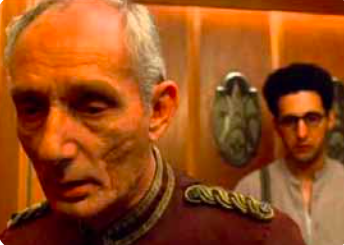
Pete (Harry Bugin)
Elevator man Pete may be more ancient than the dusty fleabag Hotel Earle where he works. The joint is itself a character in the story, walls oozing sticky goop, strangely deserted corridors, loud patterned wallpaper and carpeting. There’s hardly a sign of any guests, save for the nightly appearance of shoes left to be shined in the hallway. Aloof New York playwright Barton Fink, a guest at the Earle, is facing an existential crisis and is in the throes of depression. On a ride up in the elevator he asks Pete if he’s ever read the Bible. Pete pauses to think for a long second. “Holy Bible? Yeah, I think so. Anyway, I’ve heard about it.”
After insurance salesman Charley Meadows goes on a rampage with a double-barreled shotgun and the Hotel Earle burns to the ground, Pete is left jobless. It easy to imagine that In forced retirement he spends his remaining years poring over the Bible. Unsurprisingly, he is taken with the Book of Revelation.
“Odds Against Tomorrow” (1959)
(Mel Stewart)
Hotel Juno elevator operator (Mel Stewart), a young black man, tries to make small talk with Earle Slater, a racist ex-con, who is bound for the sixth floor. There’s a high wind outside and the elevator man jestingly compares his job to piloting airplanes. He says he ought to join the Air Force. “Ain’t gonna fly this kind of crate anymore.” But his smile evaporates when Earle stares right through him, not uttering a word. Earle exits the elevator and meets with an ex-cop who’s planning a bank job.
We can only surmise that In the coming months, the young man did indeed join the Air Force. After his brief encounter with Earle he realized that it was high time he found a better career.
“The Sleeping City” (1950)
Pop Ware (Richard Taber)
Elevators operators, perhaps more than anyone else in a building, have close contact with just about every person who works there, from executives to custodians — in other words, it’s a perfect place for a schemer. Pop Ware is an elevator man at New York’s Bellevue Hospital and the staff likes him — or so it seems. Turns out, he’s got a part-time hustle booking bets on the ponies for doctors. It’s all just harmless fun and hospital management looks the other way. But lately, interns have been turning up dead, and an undercover investigator posing as a new doctor is investigating the sudden uptick in the physician mortality rate.
Horse racing, gambling and medicine don’t really mix. The enterprising Pop Ware’s sideline was deemed not conducive to a healthful environment.
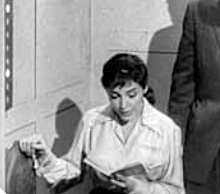
Natalie Norwick, ‘Perry Mason’ — ‘The Case of the Daring Decoy’ (1958).
“Perry Mason” — “The Case of the Daring Decoy”
Mavis Jordan (Natalie Norwick)
Some of us are born with exceptional powers of observation, and Mavis Jordan is one of the gifted few. An attractive secretary, spying on an oil executive, is found murdered in the building where Mavis operates the elevator. A bookworm, she’s constantly reading on the job, always looking down — never sees her passengers’ faces, but their shoes are another matter. The night of the murder she’s absorbed in a page-turner, “You Could Die Laughing.” She spots the killer’s shoes and becomes defense attorney Perry Mason’s star witness as he defends a man wrongly accused of the killing.
We might suppose that Mavis later moved on to a career in law enforcement, where her odd talents were more fully utilized. Faces may escape her, but she never forgets a pair of shoes
“Fall Guy” (1947)
Joe Fraser (Elisha Cook Jr.)
Joe is everyone’s pal, or so he’d like you to believe. He meets Tom Cochrane at a bar, seemingly by accident, and brings him to a party filled with seedy characters and drugs. Before the evening’s out, a sexy blonde slips Tom a mickey and he awakens on the sidewalk, clothes stained with blood, a bloody knife by his side. In a druggy haze, he vaguely remembers finding the body of a murdered girl stuffed in a closet. Tom catches up with Joe, but the elusive elevator operator dummies up, and it takes some arm twisting to get him to spill. He does, and Joe’s criminal buddies are not pleased.
With his underworld connections soon to be made public, Joe’s future as an elevator man is in doubt. But with friends like his, that’s the least of his worries.
“I, the Jury” (1953)
(Joe Besser)
An elevator operator ought to know the ins and outs of his or her building. It’s a cinch that the elevator man (Joe Besser, of late-period Three Stooges fame) in private eye Mike Hammer’s Manhattan office complex knows his stuff. He has undoubtedly helped more than a few slippery tenants avoid unpleasant situations. When the private eye is being hounded by folks he’d rather avoid, the elevator guy cheerfully tips him off about a way to hot foot it out of the service entrance in the back alley. Take the elevator up, cross over to the adjoining building, take that elevator down. As any good elevator man knows, the best plan is an escape plan.
Looking into the future, the elevator man continues to offer advice to those in a tight spot until he is replaced with an automated push-button elevator, which, alas, cannot be of assistance in such matters
While the trusty elevator operator is largely a thing of the past, he or she lives on in film and television. Ambassadors to their respective buildings, they functioned as security personnel, messengers and storehouses of local gossip. Newfangled technology may have put them out of a job, but they could never be replaced.
— Paul Parcellin