Noir comes in a number of hybrid varieties, including gangster films, heists, police procedurals and private detective stories. But some noirs don’t use standard crime film types as their foundation. Pure noirs, told from the point of view of characters who are neither career criminals nor law enforcers, plainly reveal the genre’s darkest tenets: that criminality lies within us all, like a dormant cancer.
These films are about ordinary people who discover latent criminality within themselves. Otherwise upright citizens follow their unconscious drives and repressed wishes and commit uncharacteristically malicious acts. Typically, on a whim, the noir anti-hero steps outside his protective bubble and is backed into a corner by circumstances that quickly grow beyond his control. He reacts emotionally, not with premeditated malice. The consequences he faces are inevitably bleak, leaving him with few prospects for redemption.
Here are some films that pass muster as pure noir:
Noir, straight down the line
Tom Neal, ‘Detour’ (1945).
The Past Returns ‘Act of Violence’ (1948), ‘Moonrise’ (1948)
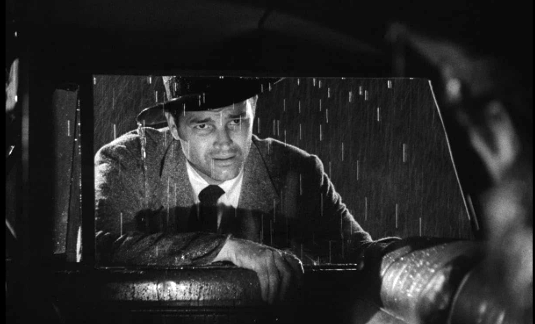
At first blush, “Act of Violence” (1948) appears to be the story of a violent stalker from New York who terrorizes a respectable small town family. The stalker, Joe Parkson (Robert Ryan), and his intended target, Frank Enley (Van Heflin), served together in World War II, where Parkson’s bitter hatred of Enley took root. Enley’s idyllic life is abruptly upended by the dangerously unbalanced veteran with murderous intentions. Yet nothing is as it seems.
Later, Enley’s timidity and Parkson’s self-righteous bullying finally make sense and our perceptions of both men take an unexpected turn. In this all-American town moral decay comes dressed in a business suit with war medals pinned to its chest.
Dane Clark, ‘Moonrise’ (1948).
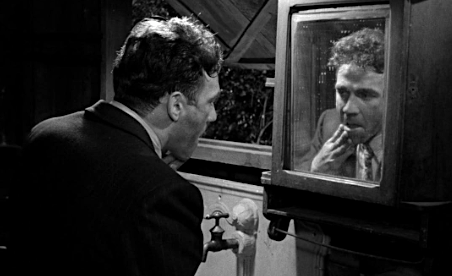
The stain of criminality is passed down through generations in “Moonrise” (1948). Tormented Danny Hawkins (Dane Clark) is the son of a murderer who was hanged. Bullied his entire life, Danny is harassed as an adult by Jerry Sykes (Lloyd Bridges). The two finally fight and tragedy follows. For Danny, the town is a psychological prison. He has internalized society’s judgment of him and noir fatalism becomes a self-fulfilling prophecy. The romantic notion of small town life as a peaceful refuge from urban decay is shattered. In its place is social rot hiding beneath the surface of a wholesome community.
Innocence Meets Malice ‘Scarlet Street’ (1945)
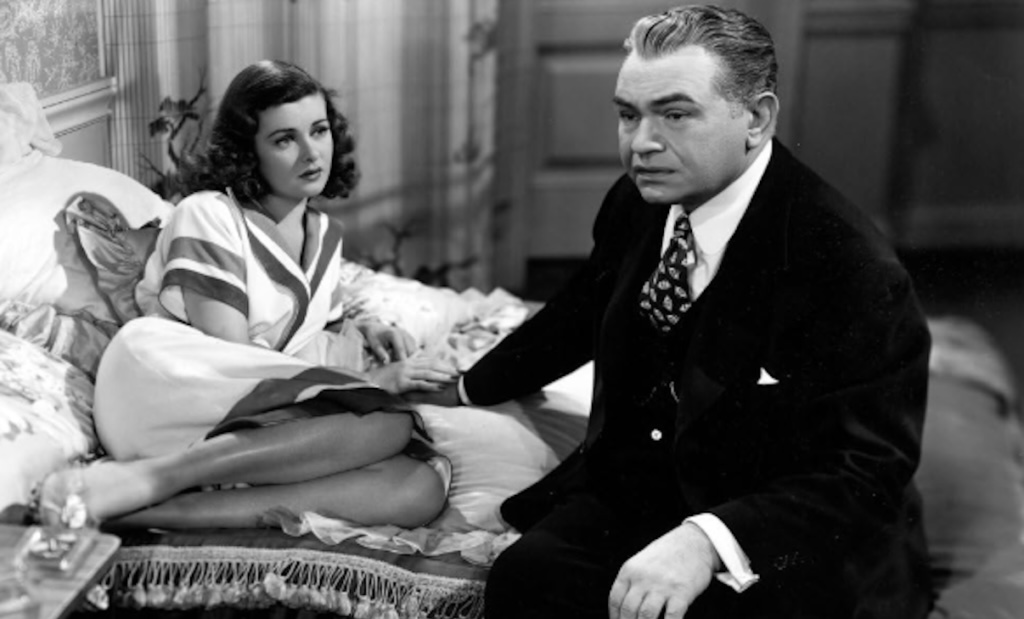
In “Scarlet Street” a milquetoast hero devolves into an antihero who earns our pity even when he makes increasingly disastrous choices. Christopher Cross (Edward G. Robinson), a gullible cashier who is also an amateur fine art painter, is pushed to the breaking point by two street hustlers who bleed him for cash. “Scarlet Street” is a study of tall tales and delusional thinking, in which everyone lies to one another. When it finally dawns on the aspiring painter that he’s been had, naiveté seems to drain from his body and he grows vengeful. But this turn of events presents him with a fate worse than incarceration or the hangman’s noose.
Ann Savage, ‘Detour. (1945)
When he switches identities with a dead man he begins a slow decline into oblivion.
On the Open Road ‘Detour’ (1945)
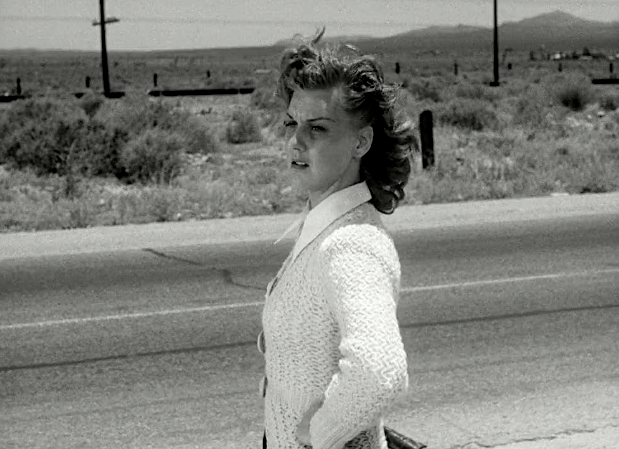
On its surface, “Detour” is a road movie with a deceptively simple plot. Saloon pianist Al Roberts (Tom Neal) hitchhikes across the country to be with his girlfriend. On his way to California he has fateful encounters with two other travelers, and through a series of flukes and missteps becomes enmeshed in capital crimes. Isolated on lonely desert roads, and out of reach from the police, he’s left to fend for himself in an alien environment. When he switches identities with a dead man he begins a slow decline into oblivion. Fate is the driving force behind “Detour,” and Roberts’ destiny aligns with noir’s most bitterly pessimistic outlook on human existence.
Minus detectives, gangsters and crime film cliches, noir is reduced to its most essential elements. At its minimalistic best, pure noir lays bare the genre’s existential core, where noir dissolves the distinction between respectable society and criminality altogether.
— Paul Parcellin