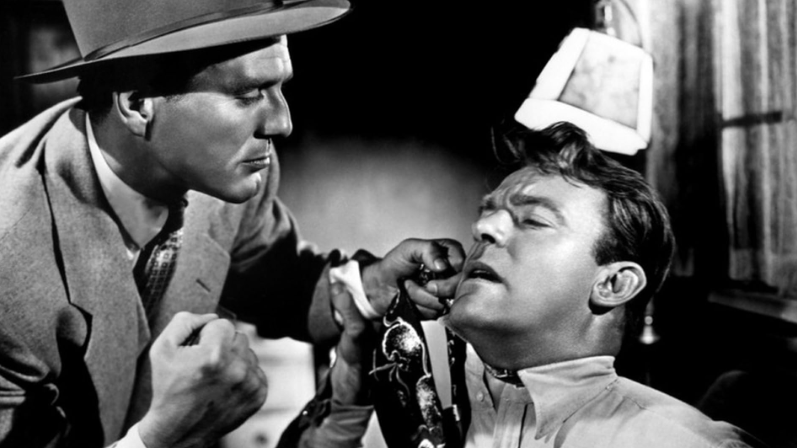
Charles McGraw, Dennis O’Keefe, ‘T-Men’ (1947).
Noir traditionally thrives on moral instability. Criminals, police, politicians and ordinary citizens occupy the same compromised terrain, where motives blur and institutions rarely deserve trust.
But a parallel strain of postwar crime films moved in the opposite direction. Documentary-style procedurals borrowed noir’s visual tension while stripping away its skepticism, replacing ambiguity with institutional certainty and turning realism into a form of public relations.
We’re left to ponder the results when noir aesthetics are used to reinforce authority rather than question it.
Noir Goes Native
When directors obsess about documentary-like realism, they’re apt to form partnerships with those in authority, and institutional cooperation inevitably reshapes the story being told. With police and government officials acting as advisers and even cast as actors, filmmakers can be pressured to exclude parts of the story that are less than flattering to cooperating officials, and inflate or invent elements that please those in power
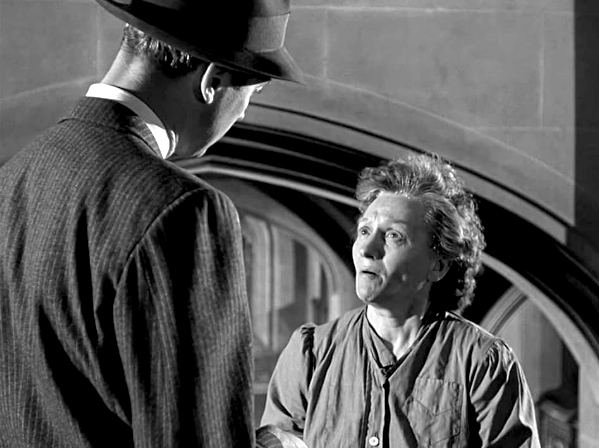
James Stewart, Kasia Orzazewski, Call Northside 777 (1948).
Procedurals provide a clean-cut version of crime and law enforcement.
Unsettling Questions Evaporate
Uneasy companions of their more existentially challenging brethren, procedurals take on the look and dramatic tensions of noir while sidestepping noir’s more prickly tenets. Unclouded by ambiguity and uncomfortable questions, procedurals provide a clean-cut version of crime and law enforcement designed to attract a larger slice of American audiences than do classic noirs. This is noir with its sharp edges sanded down and its pessimistic outlook adjusted to one far less skeptical of authority.
A Shift in Narration
Procedurals don’t quite line up with the voice and underpinnings of classic noir, and consequently split away from many of noir’s bedrock characteristics. That’s most obvious in a film’s narration. In classic noir, the antihero protagonist sometimes provides voiceover narration, but in procedurals, a government official or an anonymous “voice of God” does the talking. The classic noir narrator may be an unreliable witness or incapable of introspection, adding to the story’s texture and dramatic tension. In procedurals, an official voice of authority relates the details of a case, and we’re obliged to take as them as indisputable facts.
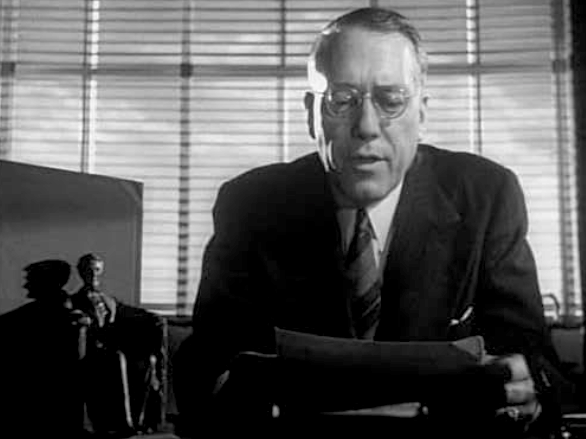
Elmer Lincoln Irey, former chief coordinator of the Treasury Department’s law enforcement agencies, introduces T-Men.
T-Men (1947), The House on 92nd Street (1945), Call Northside 777 (1948)
T-Men opens with an introduction by Elmer Lincoln Irey, the real-life former chief coordinator of the Treasury Department’s law enforcement agencies, and the film’s voiceover narration is provided by an unabashed U.S. Treasury Department booster. The House on 92nd Street uses real FBI agents and officials in its cast, and Call Northside 777 employs real-life figures involved in the actual case depicted in the film. Each film adopts a quasi-official tone by securing public officials’s endorsements, and some boast of using actual locations where the depicted crimes took place. But how much does this fixation on authenticity add to the films’ quality, and what compromises are inevitable when filmmakers are under the scrutiny of those in power?
The Politics of Noir Highway 301 (1950)
Perhaps the most blatant presentation of awkward official endorsement lies with Highway 301, a Warner Bros. procedural distinguished in part by its on-screen violence. The film opens with governors of Maryland, Virginia and North Carolina, who, one by one, get their moment on the soap box and give virtually identical speeches with the message that crime doesn’t pay. It’s a stultifying segment that almost causes the film to stall before it gets started.
The governors’ stiff performances do nothing to enhance the film’s aesthetic qualities, but probably helped cut through governmental red tape in obtaining location filming permits. While the governors’s stamps of approval may have reinforced the story’s authenticity, the trio of politicians received free national exposure, and Warner undoubtedly reaped a fair amount of regional publicity from it all.
With its violent edge, shocking for its time, Highway 301 could only benefit from those endorsements in getting the film past the censors in an era when the Motion Picture Production Code was still in force.
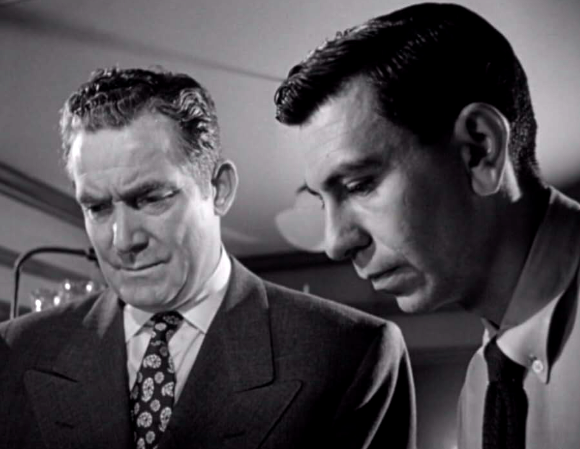
Roy Roberts, Jack Webb, ‘He Walked by Night.’
Made For Broadcast: He Walked by Night (1948)
It’s appropriate that Jack Webb plays a police department technologist in He Walked by Night, a film based on a true story that uses real locations and real police officers in the cast. Webb parlayed the docudrama style used in He Walked by Night and other films like it into Dragnet, a police procedural broadcast on radio and TV in the 1950s, ’60s and ’70s. A tireless L.A.P.D. booster, Webb transformed procedural realism into a mass-market formula in which institutional competence displaced noir’s distrust of authority. The small screen drama is the pinnacle of homogenized noir processed for mass consumption.
Documentary-style procedural noir transforms realism into institutional myth making and upends noir’s notion of morally ambiguous characters. It borrows the texture of realism from noir while narrowing the moral universe noir opened up. The streets remained dark, the shadows remained sharp, but uncertainty disappears. What survives is not noir’s skepticism, but its surface.
— Paul Parcellin